Why You Can't Stop Late Night Snacking: A Dietitian Explains
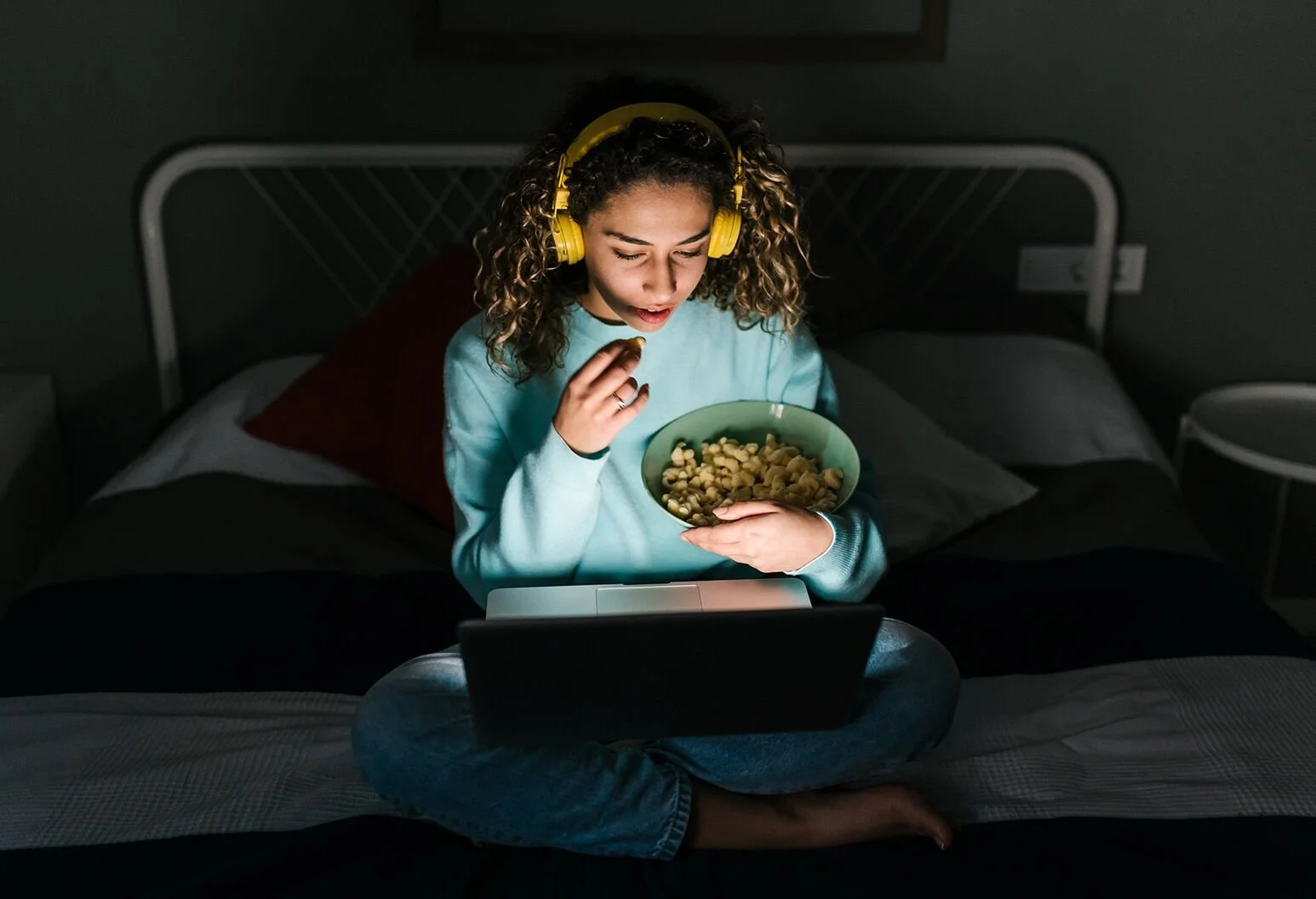
Late-night snacking. Image obtained from The Well by NorthWell
If you find yourself hungry every night, no matter how well you ate during the day, you're not alone, and you're not lacking willpower. As an outpatient dietitian, I hear this from clients all the time. Late-night snacking is usually your body trying to tell you something. Here's how to figure out what.
Are you eating enough?
You might not realize it, but underfueling during the day is one of the most common drivers of late-night hunger. Life gets busy. Whether it's back-to-back meetings on a weekday or a packed schedule on the weekend, meals can easily fall through the cracks. The fix? Start strong and start early. Prioritizing protein and fiber earlier in the day sets your body up to feel satisfied well into the evening.1 Aim to build your meals around fiber-rich carbs, a quality protein source, and healthy fats. This combination helps regulate blood sugar, appetite, and hormones throughout the day, keeping those late-night cravings at bay.2,3
2. Are your meals balanced?
If you're intentionally cutting out entire food groups, like avoiding carbs or swearing off sweets, your body will almost always push back– and late-night cravings are often how that shows up. Here's the thing: each food group serves a purpose. Carbohydrates fuel your brain and body, protein keeps you full and supports muscle, fats help with hormone regulation and satisfaction, and fiber keeps digestion and blood sugar steady.2,3 When one piece is missing, your body notices. You might eat plenty of food but still feel unsatisfied, or find yourself hungry again an hour later.
Including all food groups, even the ones you've labeled as "off limits," can actually help you feel more in control of your appetite, not less. If you currently have to keep certain foods out of the house just to avoid eating them, this is not a long-term solution. The real goal is getting to a place where all foods can exist in your kitchen without calling your name all night, which is more achievable than you might think.
3. Are you eating dinner too early?
When you eat during the day matters just as much as what you eat. If you're eating dinner at 5 pm but not going to bed until 11 pm, that's a six-hour gap, which is plenty of time for hunger to creep back in. Your body can only stay satisfied for so long after a meal, especially if dinner wasn't substantial enough to begin with.
If early dinners are unavoidable for your schedule, a planned evening snack might actually be the smarter move rather than trying to “tough it out” through hunger until bedtime. Think of it less as "giving in" and more as intentional fueling. A small balanced snack, something with protein and fiber, can bridge the gap without derailing your appetite for the next day. The goal is to work with your body's hunger cues, not fight them.
4. Are you sleeping enough?
Sleep and hunger are more connected than most people realize. When you're not getting enough quality sleep, your body produces more ghrelin — the hormone that signals hunger — and less leptin, the hormone that signals fullness.1,2 The result is that you feel hungrier than usual, often for higher-calorie, quick-energy foods. It can feel like a willpower issue when it's actually a biology issue. Prioritizing consistent and quality sleep is one of the most underrated tools for managing appetite and reducing late-night cravings.
5. Are you stress-eating?
Maybe you ate balanced meals and got enough food throughout the day, but the cravings still hit at night. This one's worth paying attention to. Food can be genuinely comforting and can activate reward pathways in the brain,4 making it a very easy (and human) way to unwind after a long or stressful day. The problem is that eating to cope with stress usually happens on autopilot, which means you're often not even hungry when it starts. If this resonates, it's worth asking yourself what you're actually feeling when the cravings hit: boredom, anxiety, exhaustion? Identifying the trigger is the first step to finding a different outlet.
Late-night snacking is rarely just about willpower or self-control. It's usually your body sending a signal worth paying attention to. If one of these reasons resonated with you, you're already one step closer to figuring out what yours is saying. Keep following along for more evidence-based nutrition advice that actually fits into real life.
XO,
Leslie Saldana, MS, RD | SaldanaNutrition
References
Jigeer G, Huang Z, Wang P, et al. Longitudinal associations of skipping breakfast and night eating with 4-year changes in weight and waist circumference among Chinese adults. Am J Clin Nutr. 2024;120(2):442-448. doi:10.1016/j.ajcnut.2024.05.021
Ma J, Stevens JE, Cukier K, et al. Effects of a protein preload on gastric emptying, glycemia, and gut hormones after a carbohydrate meal in diet-controlled type 2 diabetes. Diabetes Care. 2009;32(9):1600-1602. doi:10.2337/dc09-0723
Dinu M, Colombini B, Pagliai G, et al. Effects of a dietary intervention with Mediterranean and vegetarian diets on hormones that influence energy balance: results from the CARDIVEG study. Int J Food Sci Nutr. 2020;71(3):362-369. doi:10.1080/09637486.2019.1658723
Alonso-Alonso M, Woods SC, Pelchat M, et al. Food reward system: current perspectives and future research needs. Nutr Rev. 2015;73(5):296-307. doi:10.1093/nutrit/nuv002
Taheri S, Lin L, Austin D, Young T, Mignot E. Short sleep duration is associated with reduced leptin, elevated ghrelin, and increased body mass index. PLoS Med. 2004;1(3):e62. doi:10.1371/journal.pmed.0010062
Centers for Disease Control and Prevention (CDC). Effect of short sleep duration on daily activities--United States, 2005-2008. MMWR Morb Mortal Wkly Rep. 2011;60(8):239-242.